
(Disclaimer: I watched the Japanese version with English subtitles; a friend mentioned that the English dub is a bit heavier handed and some of the subtleties are obscured)
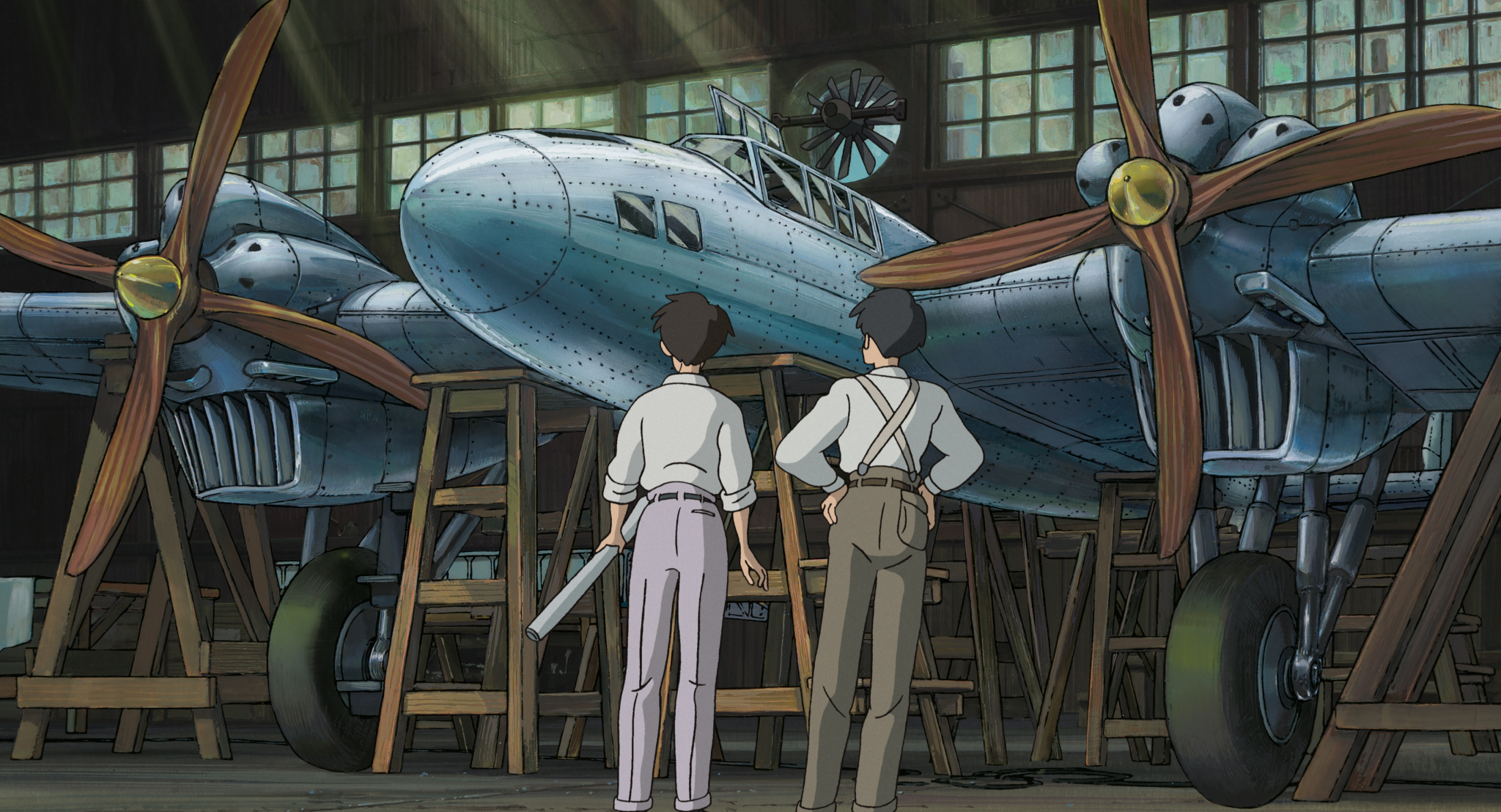 Hayao Miyazaki has been hailed as one of Japan's finest animators and artists of our time, bringing us such beautiful films as Spirited Away, Howl's Moving Castle and Kiki's Delivery Service. After creating a film for over three decades, The Wind Rises was Miyazaki's final film before announcing his retirement in September 2013 and was nominated for an Academy Award for "Best Animated Picture". Hayao Miyazaki has always had a certain fascination with flight, such as Kiki's broomstick and Howl's wizarding capabilities and the aircrafts of war, so it is not really surprising that his last film would follow suit. The film follows aeronautical engineer Jiro Horikoshi as he aspires to engineer the most beautiful airplane. The film begins with his childhood in a traditional Japanese household and ends with the test flight of his prototype in the rapidly industrializing nation before the start of World War II.
 This is perhaps Miyazaki's most complex films both in terms of plot and character development. The film had a slow build for me in the first half. Although the 'goal' is introduced early on, in a similar way to most of his films, we see Jiro going through school and his company faces failure after failure. It isn't immediately apparent how the protagonist is going to achieve his goal and what's more, the aforementioned 'goal' doesn't even seem to be the driving force of the action. Throughout the film, we see relationships being built and scenes that aren't serving immediately to bring him closer to his dream. Furthermore, because the film is a biopic it is the first film that is based in reality rather than in the fantastical. Audiences are meant to relate to what's going on on the screen rather than use the film to escape the mundane as they have before. In many of his previous films, a quest is outlined for the protagonist and is eventually resolved at the end of film with all problems being solved. In The Wind Rises, the plot is much more bittersweet and in my opinion, realistic. At the same time that something wonderful happened for Jiro, something terrible happened as well. But despite that, we are not meant to think that the end of the film was the stopping point for the characters. Rather, we as viewers were privileged to see a part of his life that continued after the film. Although tragedy strikes, it is not the end of Jiro's life-he simply goes on. The great exception to the film's reality of course are the dreamscapes, which remind me of whimsical versions of the dream palaces we see in Sherlock. These times allow Jiro to predict and solve problems in design as well as 'meeting' people, like his idol, an engineering virtuoso by the name of Caproni. Nevertheless, the film remains grounded in the fact that for the most part it is trying to portray a time and place that really existed.
 It also attempts to portray people that really existed. Although there was of course some creative license with the characters, there was actually an engineer named Jiro who designed airplanes for the military. In a slight departure from his other films, I didn't find any one character to be compelling in particular. Jiro is portrayed as the dreamer but lacks some of the charisma of Howl or Ashitaka; Naoko is beautiful and sweet but isn't feisty like Kiki. But rather than creating one character to bear the weight of the film on their shoulders, I think that Miyazaki effectively shows many nuances of human nature that he simply could not do in any of his other films. In many ways, the characters uniformly feel more mature, which will certainly resonate with older audiences. While there have been adults in the other films, they are usually they are depicted as evil or petulant. In previous cases, many of the protagonists are children and the film is their bildungsroman but we do not see them after they've come of age. The characters in The Wind Rises are mainly adults and deal with situations that I think a lot of young adults can relate to- like rerouting a dream, persistence despite failure and especially losing a loved one. I especially think that he shined at showing compassion in the face of adversity: friendship in spite of professional competition, love in spite of the inevitable end. It is the ordinary small moments that I think make the film so extraordinary. The film is not built on cinematic shots and encounters with magical beasts, but rather on subtle moments like Jiro not being able to control tears falling onto his designs or holding his wife's hand while he continues to work late at night. Rather presenting than a one dimensional hero or heroine on a quest, the film seeks to show a time and place-which is refreshing but also made a strong impression.
Joe Hisaishi returns to score the film with the Yomiuri Symphony Orchestra. Admittedly, I had to go back and find the soundtrack online because it is so secondary compared to the film action itself. That is not to say that the music was not important to the overall film but compared to how different the film itself, the score is much more prototypical of Hisaishi's other work. However, it is notable that Hisaishi chose to use a guitar as the solo instrument for many of the tracks as opposed to the piano. Although many of his works have been transcribed for guitar, I think this is the first to use it in the original score. The use of guitar in conjunction with that of an accordion ties the film strongly to the European musical tradition, which is fitting considering how much of the film is spent idolizing German and Italian engineering innovation. In one reiteration of the main theme, Hisaishi makes use of the brass section and drums to underscore the military aspect of the film toward the end of the film. I'm actually a little surprised he didn't use more wind instruments but perhaps that is a little too obvious a choice. Personally, there is no one memorable ear-worm melody that I can pick out at random and I am not likely to listen to the soundtrack out of the context of the film-it doesn't really make sense without the screenplay. However, the music nicely supports the overall feel of the film as a whole.
The Wind Rises is quite a departure from the Miyazaki's past work and many critics have noted that the film seems to be reflective of Miyazaki himself, a myopic dreamer. When it was released, the film was highly controversial given that many parts of the world have not healed yet from the damage inflicted by the Kamikaze missions, conducted by airplanes engineered by the real-life Jiro. While I don't have enough a background in history to really comment on the political nature of the film, I found the film to be exceptionally complex compared to his previous work. If you were expecting the usual feel-good Studio Ghibli film à la Totoro, this is not the film for you. While still a beautiful artistic piece, The Wind Rises is not flashy and theatrical in the way that his other films have been but I think it is probably his most well-written film. The Wind Rises is both sentimental and poetic but not overly so-the perfect culmination to a long and distinguished career in animation.

No comments:
Post a Comment